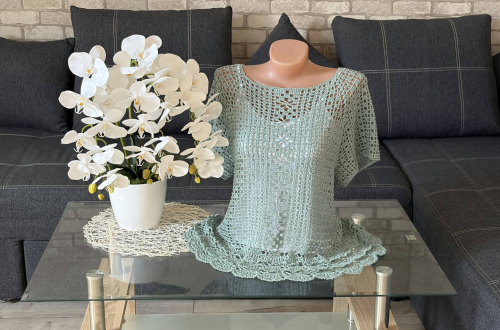
Knitted Linen Dress “Melange”
And here is yet another linen dress this season! I very rarely make summer garments with knitting needles. Mostly I crochet lace tops and dresses.
But recently a new yarn came into my hands, LINUM, 100% linen, soft and tender (that rarely happens!).
I knitted swatches and realized that it is a perfect choice for knitting needles. That is how the idea of knitting one more summer dress was born.
I will use two types of yarn.
The main yarn is 100% linen, LINUM, 1300 m/100 g. I knitted with 5 strands held together, so the yarn weight is 260 m/100 g (1300/5 = 260 m).
The additional strand is “royal sequins” on a cotton base, 250 m/100 g. I knitted it as a single strand.
3.5 mm needles.
All my dresses are knitted from the top down. And that means any design can be turned into a top, a T-shirt, a tunic, or a short or long dress. You can even use it as an idea for knitting jumpers and pullovers for cooler seasons.
The “Melange” dress is no exception: we knit it top-down, seamless. The basis is a round yoke; we begin at the neckline and continue knitting the garment in rounds from there.
I am knitting the dress in size 48–50 (≈ EU 42–44, M–L). I will briefly tell you about the main technical points.
A detailed stitch-by-stitch pattern can be purchased in the “Shop/Patterns” section.
On 3.5 mm needles we cast on 160 stitches + 1 stitch to join in the round. For a narrower neckline, cast on fewer stitches, for example 120–140. We knit the yoke in rounds, working even increases as we go to widen the fabric.
Once the yoke has reached the required height, we divide the total number of stitches into 4 parts, based on the figure: the front, the back and two sleeves.
On the back stitches we knit the Asian-style back raise in short rows, about 4–6 cm.
We measure the width of the front and the back of the yoke. Then we do the calculations for the underarms.
We continue knitting the dress in rounds, put the sleeve stitches on spare circular needle cables, and shape the underarms.
From the waist line we start working increases for the lower part of the dress. I want to knit a trapeze dress.
When trying it on, we pay attention to the width of the garment and the overall fit on the figure. As you knit, you can and should adjust the number and rhythm of the increases.
The dress is knitted with simple lace patterns, stockinette stitch and a few rows of purl stitches, without strict regularity in the repeats.
We knit the lower part of the dress in lace pattern no. 19 from the magazine “280 Lace Patterns”. The pattern repeat is 8 stitches and 8 rows.
The openwork hemstitch is worked from pattern chart no. 159, just three rows: 8, 9, 10.
The main body of the dress is done. Length of the garment 98 cm.
Width of the dress at the bottom edge 92 cm.
Yarn used at this stage 425 g (including 14 g of royal sequins).
This dress can have short sleeves, 3/4-length sleeves or long ones. It is all up to you. I want a long puff sleeve.
We move on to the sleeves. The stitches for each sleeve were left on spare cables. Along the underarm edge and along the side of the back neck raise I cast on the necessary number of additional stitches.
I knit straight fabric up to the elbow, then begin working even increases to form the “puff”. At the bottom of the sleeve there is a small cuff.
The dress is finished! It turned out both simple and elegant.
Size 48–50. Length of the garment 98 cm.
Width of the bottom edge of the dress 92 cm.
Total yarn used for the whole garment 600 g:
- 100% linen – 580 g;
- royal sequins 20 g.
A detailed stitch-by-stitch pattern can be purchased in the “Shop/Patterns” section.
You may also like
Crochet Jacquard Sweater “Tiramisu”
February 26, 2020
Filet Crochet T-Shirt “Crane” in Linen-Viscose Yarn
May 11, 2026