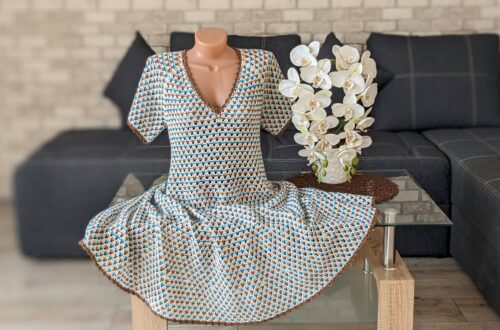
Knitted Ethnic Style T-Shirt “Viburnum” with Jacquard
I really love ethnic-style pieces, so here is one more knitted vyshyvanka for you.
It can be a summer T-shirt or a dress if you knit it in linen, cotton or bamboo. Or take merino or a merino blend, and you will get a wonderful sweater for autumn.
For this creative project I chose Wexford cone yarn (linen/cotton), 1660 m/100 g.
I have two shades: light green and pine green. I knit with 6 strands held together (the thickness of the yarn is about 277 m/100 g), on 4 mm needles.
The gauge is 19 stitches × 24 rows = 10 cm.
I am adding the calculations for size 48–50 (≈ EU 42–44, M–L).
The knitting process.
We knit the front and the back separately. For the back, cast on 104 stitches. I start knitting with a wrong-side row, working purl stitches. Knit a straight, even piece in plain stockinette. At 56 cm from the cast-on, begin shaping the shoulder slopes. To do this, bind off 5 stitches, 5 times, at the beginning of every row (both RS and WS rows) (see the video below). I started the bind-offs on the wrong side at row 141, and on the right side at row 142.
You are left with 104 – 25 – 25 = 54 stitches on the needles.
Bind off the remaining stitches in one row. On the back I leave a straight neckline, with no shaping. Yarn used for the back: 120 g. Length: 63 cm.
The color of the fabric looks different under different lighting.
Next, we move on to the front. This is where it gets much more interesting.
Cast on 105 stitches. Work 51 rows of plain stockinette (these rows are not on the chart!), starting with a wrong-side row. That is about 20 cm. Then switch to the jacquard pattern following the chart. Mark 16 stitches at each edge with markers (these stitches are not on the chart!), and the “Viburnum” pattern will be worked over the central 73 stitches.
From row 43 of the chart, divide the fabric into two parts. From here on, each front half is knitted separately. Make an extra stitch from the central stitch of the front so that each half has 53 stitches. Continue knitting following the chart.
Left front. At the beginning of row 88 of the chart (a wrong-side row), start shaping the neckline by binding off the first 10 stitches. Then, in the following wrong-side rows, bind off stitches like this:
- twice 4 stitches,
- twice 3 stitches,
- once 2 stitches,
- once 1 stitch.
At the same time, shape the shoulder slope. To do this, bind off the first 5 stitches at the beginning of row 91 of the chart (a right-side row). Repeat 4 more times in the following right-side rows. The shoulder slope takes 5 groups of 5 stitches bound off.
Right front. Work it symmetrically to the left front. Start the neckline shaping at row 87 of the chart (a right-side row). Start the shoulder slope at row 90 of the chart.
Yarn used for the front: 130 g, of which light green 105 g and pine green 25 g. Length: 63 cm.
Two pieces are ready. Join them together and sew the shoulder and side seams. Then you can crochet an edging around the neckline and the bottom edge. For example, as I did: 2 single crochet, then a picot of 3 chains. I edged the front neckline with single crochet worked in the reverse direction.
The body with the edging weighs 265 g.
Then we move on to the sleeves. We begin by shaping the sleeve cap in short rows. To do this, pick up the first 12 stitches along the edge stitches, on the right side of the fabric (the upper center part of the sleeve).
Turn the work to the wrong side, slip the first stitch, then purl. At the end of the row, add 5 new stitches picked up from the edge stitches of the armhole.
Turn the work to the right side, slip the first stitch, then knit. At the end of the row, add 5 new stitches picked up from the edge stitches of the armhole.
Keep going like this, picking up new stitches (at the end of each row) all along the armhole. I ended up with 62 stitches. That is enough for the sleeve width I wanted. Then I knit the sleeves in the round to the length I needed. I finished the edge with a crochet border.
All that is left is to add the important decorative elements. Make two cords with a crochet hook or on a knitting mill, and make tassels. Attach them to the finished piece.
Total yarn used: 320 g:
- light green: 270 g,
- dark green (pine): 50 g.
I wish you all inspiration and happy knitting!
You may also like
Round Yoke Sweater Knitted with Angora and Beaded Cotton
November 23, 2023
Knitted Top-Down Raglan Sweater “Soft Pearl” with Beads
July 6, 2025