For Women,  Knitting Projects,  Sweaters, Jumpers & Pullovers

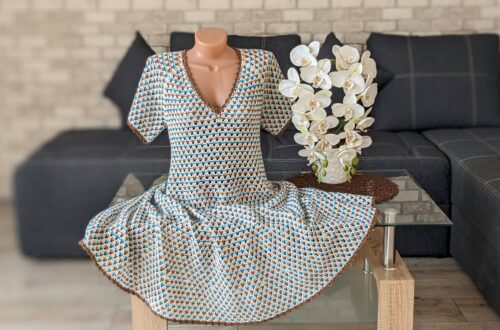
Knitted Lace Jumper with Openwork Diamonds

It is only the middle of February, but spring is already in the air. The sun appears on our horizon more and more often, inspiring us to create delicate, lacy, fluffy things. But everything in its time, so for now we keep knitting warm clothes.

For this jumper I chose the softest alpaca, Persiano (baby alpaca, merino, PA), 800 m/100 g. I knit it with two strands on 4.5 mm needles.

Before knitting I made several swatches. The one I liked best was the openwork diamond pattern, and I’ll add the chart below. The pattern repeat is 13 stitches. For the swatch I cast on 30 stitches (two repeats + 2 stitches for symmetry + 2 edge stitches).

My swatch is 16.5 cm wide. So, at my gauge, one repeat of the lace pattern is about 8 cm wide.

For a width of 56 cm we need 7 pattern repeats, and we convert that into stitches:

7 repeats × 13 stitches (one repeat) = 91 stitches.

I’m knitting size 48–50 (≈ EU 42–44, M–L). So, we start knitting the jumper bottom-up in one piece. For the body (front and back) cast on 182 stitches on 4.5 mm needles. Work 10 rounds of 1×1 rib in the round. Then move on to the lace pattern following the chart. Knit the body to 40 cm (up to the armholes).

Next we divide the body stitches in half: 182 / 2 = 91 stitches. We will knit each half separately. If you like, you can make a gradual transition from the lace pattern to stockinette stitch.

For the back: we have 92 stitches, and we add 1 stitch for symmetry while working the pattern. 20 cm above the armholes we start shaping the shoulder slopes, and at 23 cm the neckline.

After the lace pattern I worked 30 rows of stockinette stitch, started shaping the shoulder slopes from rows 31/32, and the neckline from row 37.

For the front: we have 90 stitches, and we add 1 stitch for pattern symmetry and 2 edge stitches (I explain this in detail in the video, part 1). The shoulder slopes are shaped as on the back. The neckline starts one row lower than the slopes.

After the lace pattern I worked 28 rows of stockinette stitch, started shaping the neckline from row 29, and the shoulder slopes from rows 31/32.

I’ve added the diagram showing how the shoulder slopes and neckline are shaped to the gallery below.

Now the shoulder seams: join the open shoulder-slope stitches in pairs.

The body is 66 cm long. The yarn used at this stage is 150 g.

Next we move on to finishing the neckline with a mock-linked edge. See the detailed video below, part 3.

Next we move on to knitting the sleeves.

We start by shaping the sleeve cap in short rows. To do this, on the right side of the fabric, pick up the first 6 stitches from the edge stitches (the upper center part of the sleeve).

Turn the work to the wrong side, slip the first stitch, then purl. At the end of the row add 6 new stitches from the edge stitches of the armhole.

Note! You can increase the number of stitches by using yarn overs between stitches. For example, pick up two stitches from the edge stitches, then make one yarn over, and so on.

Turn the work to the right side, slip the first stitch, then knit. At the end of the row add 6 new stitches (from the edge stitches of the armhole + yarn overs).

Keep going and add new stitches at the end of every row all around the armhole. I ended up with 66 stitches. That is enough for the sleeve width I wanted. Then I knit the sleeve in the round to the length I need.

Before the cuff I decrease evenly: knit 1, k2tog, and so on. 44 stitches remain on the needles. Then work 8 rounds of 1×1 rib, followed by 2 rounds of tubular rib. Bind off with a tapestry needle.

I knitted the jumper in size 48–50.

The finished piece is 66 cm long. The yarn used is only 230 g.

The jumper turned out warm, delicate and weightless.