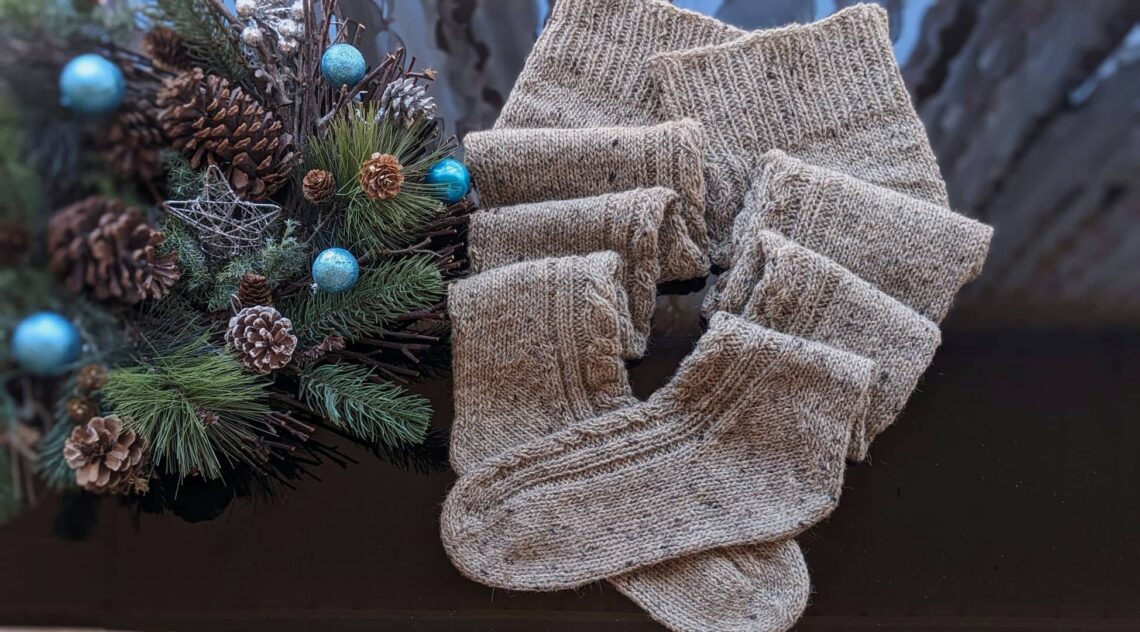
Knitted Tweed Thigh-High Socks – Toe-Up Pattern
Tweed is a material with natural resistance to wear, which makes it a great choice for everyday use.
Tweed fabric has a characteristic uneven texture with tiny flecks of color that add depth and uniqueness to a piece. It is an ideal choice for making things that not only keep you warm but also carry authenticity and style.
Things made of tweed yarn easily become favorites, because they radiate warmth and comfort. To go with the sweater dress I told you about earlier, I decided to knit warm, extra-long socks – thigh-highs. The result is a great set – feminine and cozy.
TIBET tweed yarn by Zegna Baruffa, 290 m/100 g. Beige with a gray undertone.
Content: 85% merino wool, 10% alpaca, 5% wool. 4 mm needles.
I knitted these socks in size 38–39 (EU). Foot length 25 cm, leg length 82 cm. A pair of socks takes 190 g of yarn. I added the chart of the textured pattern below, in the gallery.
We start knitting the sock from the toe. For one sock, cast on 10 stitches onto the needles using the Turkish method (wrapping the yarn around the needles).
Work the first round, which forms two sides of the sock with 10 stitches each. That means each needle should hold 10 stitches.
From the next round, at the edges of each side, we widen the fabric by adding stitches from the bar. We keep shaping the toe in rounds. Repeat these increases in every 2nd round until there are 22 stitches on each needle. That’s it, our toe is done.
To see how to do the Turkish cast-on and shape the toe, watch the video from minute 23.
In this video I also showed the cast-on and toe shaping in detail
Next we shape the foot. We have two needles with 22 stitches each – these are the two halves of our sock. The bottom half is worked in stockinette stitch, 22 stitches on the needle.
On the top half we start the textured pattern, over the 22 stitches of the top needle: k1, p2, k2, p2, k8 for the textured pattern, p2, k2, p2, k1.
Knit the foot to the length you need.
After 17–18 cm, start increasing stitches for the gusset. On the bottom half of the sock, next to the edge stitches, add new stitches from the bar 10 times, in every 2nd round.
Knit in the round. On the bottom needle: 10+22+10 = 42 stitches. You can see the knitting process in detail in the video below – part 2.
Next we start decreasing stitches, also in every 2nd round. On the bottom half of the sock, mark the 2 center stitches and begin working back and forth in short rows:
Row 1: k20, k1 (of the marked center stitches), k2tog with the 2nd marked center stitch and the next one, k1. Turn the work to the wrong side.
Row 2: slip 1, p2, p2tog, p1. Turn the work to the right side.
Row 3: slip 1, k3, k2tog, k1. Turn the work to the wrong side.
Row 4: slip 1, p4, p2tog, p1. Turn the work to the right side.
Row 5: slip 1, k5, k2tog, k1. Turn the work to the wrong side.
And so on… Keep decreasing; you should have 9 decreases on each side.
Next we go back to working in the round, and work the last decreases (1 stitch from each side of the bottom half) in this round. The bottom needle should again have 22 stitches.
Then knit the leg in the round to the length you need. On the back, mark 2 center stitches; we will increase next to them in every 12th round. Make the increases from the bar, or in any other convenient way. Each of these rounds adds two new stitches. I kept increasing until the leg had 70 stitches in total.
You may also like
Wild Grape Beret: Easy Knitted Beret with Rib Band
November 14, 2023
Textured Top-Down Raglan Sweater in Merino and Cashmere
December 9, 2024