For Women,  Knitting Projects,  Sweaters, Jumpers & Pullovers

Textured Top-Down Raglan Sweater in Merino and Cashmere

A knitted sweater with a textured pattern combines beauty, warmth and practicality. In the cold season such a sweater is a real lifesaver: it not only keeps you warm, but also gives your look originality. The textured pattern makes the sweater unique and draws attention.

The process of knitting itself lets you create something that perfectly matches your needs and taste: choose your favorite yarn, pick the colors and add special details. Such a sweater becomes a wardrobe basic, because it is easy to combine with different styles of clothing. It is perfect both for a walk through the winter city and for a cozy evening at home. It is not just clothing, but a warm accent that will always stay in style.

For this project I chose an interesting hand-dyed yarn. Fiber content: 70% merino, 30% cashmere. Yardage: 300 m/100 g. 3.5 mm needles for the neckline and cuffs, 4 mm for the main body and sleeves.

I added the chart of the textured pattern to the gallery below. It adapts very well to being worked in the opposite direction. Work the odd rows according to the chart; the even rows as they appear (knit the knits, purl the purls).

We knit the sweater from the top down. So take the chart, turn it so that the first row is at the top, and begin knitting from the last row of the chart, that is, in the reverse direction.

Chart key:

  • empty squares – knit stitches,
  • black dot – purl stitches,
  • slanted lines – crossing of a knit and a purl stitch, leaning left/right.

The model is a classic top-down raglan sweater with a straight silhouette.

I am knitting size 48–50 (≈ EU 42–44, M–L). The width of the piece should be about 52–54 cm.

We knit the sweater from the top down, in one piece. We start at the neckline. On 3.5 mm needles cast on 100 stitches + 1 stitch to join in the round. Work 25 rounds of 2×2 rib in the round.

After the neckline, divide the total number of stitches into sections and mark them with markers:

  • back – 30 stitches,
  • front – 42 stitches,
  • two sleeves – 10 stitches each,
  • four raglan lines – 2 stitches each.

Change to 4 mm needles. Start knitting the yoke in the round, working the textured pattern on the back/front stitches and stockinette stitch on the sleeves.

The first row of the pattern on the back stitches is worked like this:

  • 8 purl,
  • 2 knit,
  • 10 purl,
  • 2 knit,
  • 8 purl.

The first row of the pattern on the front stitches is worked like this:

  • 2 purl,
  • 2 knit,
  • 10 purl,
  • 2 knit,
  • 10 purl,
  • 2 knit,
  • 10 purl,
  • 2 knit,
  • 2 purl.

Work the increases next to the raglan lines on every 2nd row, the same for all sections. Work the new stitches into the pattern according to the chart.

After working 20 cm of the yoke (not counting the height of the collar), the number of stitches at this stage is:

  • back – 84 stitches,
  • front – 96 stitches,
  • two sleeves – 64 stitches each,
  • four raglan lines – 2 stitches each.

I put the sleeve stitches on waste yarn. I divide the raglan line stitches equally between the sections. Now we work the Asian-style back raise in short rows on the back stitches + 2 raglan line stitches (1 stitch from each side).

On the needles: 1 + 84 + 1 = 86 stitches.

The height of the back raise is 10 wrong-side rows of the pattern, about 4–5 cm.

Next, we continue with the main body in the round. Join the back, front and raglan line stitches, and add stitches for the two underarms, taking the pattern repeat of the textured pattern into account. I have 10 stitches for each underarm.

The total number of stitches of the body is:

86 (back + raglan lines) + 10 (underarm) + 98 (front + raglan lines) + 10 (underarm) = 204 stitches.

Knit the body to the required length.

At the bottom, switch to 2×2 rib. I did not change the needle size. Work 20 rounds of rib. I bind off with a yarn over.

Yarn used at this stage: 250 g.

Next we move on to the sleeves.

On the waste yarn there are 66 stitches for each sleeve (64 sleeve stitches + 2 raglan line stitches). Pick up additional stitches along the edge of the underarm and back raise to get the desired sleeve width. I picked up 14 additional stitches. On the needles: 66 + 14 = 80 stitches.

If the total number of stitches turns out to be more than needed, decrease the extra stitches in the first rounds of the sleeve (at the corners of the underarm).

Knit the sleeves in the round to the required length.

Before the cuff, switch to 3.5 mm needles and evenly decrease 20 stitches, working: k2, k2tog.

On the needles: 80 – 20 = 60 stitches. I work 12 rounds of 2×2 rib. I bind off with a tapestry needle (I add a video below).

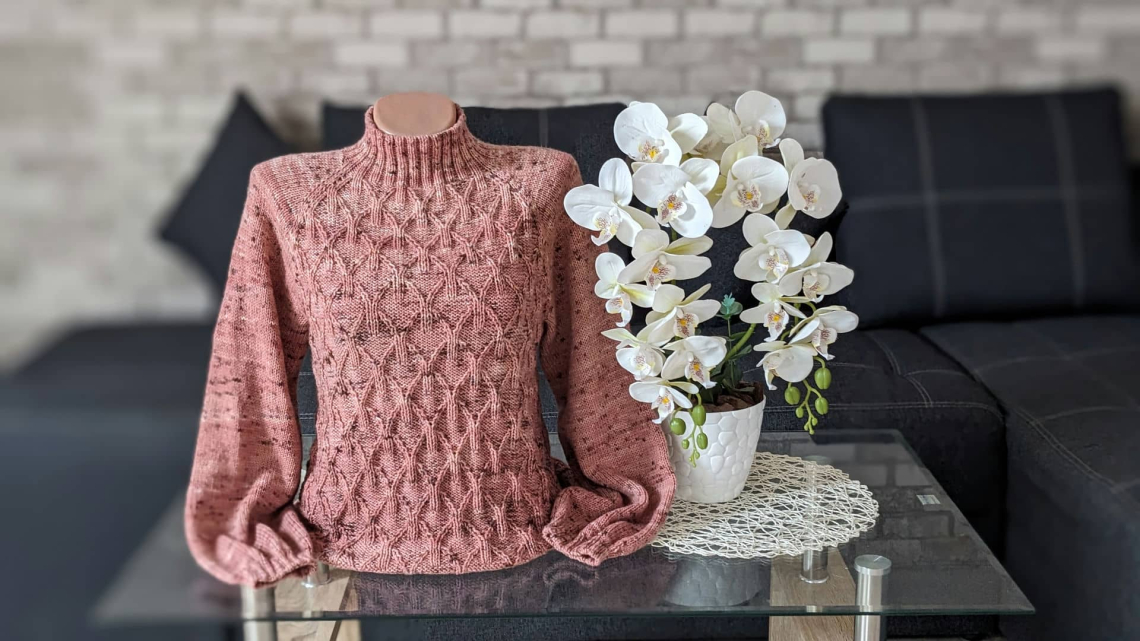
Our sweater is finished. Size 48–50, length 62 cm, yarn used 390 g.

Happy knitting, and may your stitches be even! May everything turn out well for you!