For Women,  Knitting Projects,  Sweaters, Jumpers & Pullovers

Cotton Sweater with Leaf Lace Pattern and Boat Neckline, Knitted Bottom-Up

Summer goes on!
I am starting a sweater from thick cotton. It is not for hot weather, but it will be a lovely choice for cool summer evenings and for spring and autumn. You can pair this sweater with trousers, shorts and skirts. And with medium-weight yarn, any piece can be knitted quite quickly.

For this sweater I chose cone cotton, 250 m/100 g, and 4 mm needles.
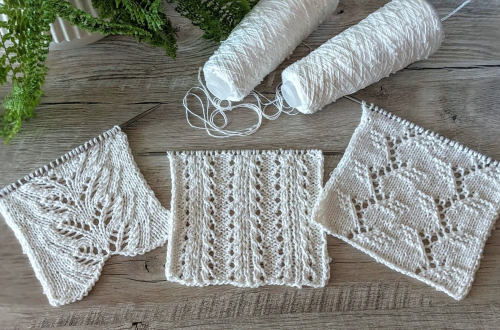
I tried knitting various patterns with this yarn. My favorite in the fabric was the vertical leaf lace pattern from the magazine “280 Openwork Patterns”.

Gauge over 10 cm: 19 stitches × 20 rows.

I worked out the calculations for a finished width of 56 cm.

You can watch the whole knitting process in detail in the video (see below).

We knit the main part of the sweater bottom-up in one piece.

On 4 mm needles I cast on 210 stitches + 1 stitch for joining in the round. Work 14 rounds of 1×1 rib. Then switch to the leaf lace pattern.

The pattern repeat (across) is 15 stitches.

Around the whole round we will have 14 repeats: 210 stitches/15 stitches per repeat = 14 repeats.

Knit a straight, even fabric to the desired length up to the armholes (for me it is 36 cm).

Next we divide all the stitches equally into two parts: front and back (210/2 = 105 stitches).

Continue each part separately, worked flat (back and forth). Shape the neckline and the shoulder slopes following the pictures. On every 2nd row, bind off stitches for the neckline, and leave each next group of stitches unworked to shape the shoulder slope.

In my sweater I want a wide neckline so that it can be worn off the shoulder.

The main part is almost done. Join the live stitches of the shoulder slopes with a tapestry needle, using the Kitchener stitch (video, part 1).

Next we finish the neckline using the mock-linked edge method (video, part 2).

To do this, on 4 mm needles I pick up 148 stitches around the whole edge of the neckline.

Then we work as follows:

Row 1: knit.

Row 2: double the number of stitches. Knit the stitches of the previous row again and alternate them with new stitches, which you pick up from the half-stitch (bar) on the wrong side. Purl these new stitches.

On the needles: 148 sts × 2 = 296 stitches

Row 3: k1, slip 1 purlwise, and continue like this across the whole row.

Row 4: slip 1 knitwise, p1, and continue like this across the whole row.

Row 5: knit all stitches together in pairs (k2tog). The number of stitches is halved.

On the needles: 296 sts / 2 = 148 stitches.

Rows 6–12: 1×1 rib.

Row 13: work as row 3.

Row 14: work as row 4.

Then bind off with a tapestry needle.

Now we move on to the sleeves (video, part 3).

We start from the bottom, at the cuff. On 4 mm needles cast on 40 stitches + 1 stitch for joining in the round. Work 15 rounds of 1×1 rib. In round 16 increase the number of stitches: make a yarn over after every 2 stitches. After that there will be 40 sts + 20 sts = 60 sts on the needles.

Then switch to the lace pattern. Work 4 repeats in the round.

Knit the sleeves from the cuffs as a straight, even fabric to the required length (up to the start of the armhole). After that, begin shaping the sleeve cap (the upper part), worked flat. At the beginning of every row (both RS and WS) bind off three stitches.

Continue binding off until the last stitch. The sleeves are done; sew them to the main fabric with a tapestry needle.

This is the summer sweater with a wide neckline that I ended up with.

Size 48–50 (≈ EU 42–44, M–L). Finished length: 62 cm.

Width of the main part of the sweater: 56 cm. Yarn used: 540 g.