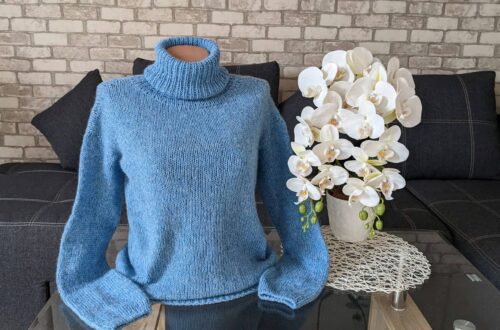
Top-Down Knitted Plush Dress with Raglan Yoke
A bright new project is in full swing. It could become a sweater, a dress or a tunic. It all depends on your preferences and how much yarn you have.
I really want to knit a simple, cozy and practical dress.
⠀
I’m using cone plush yarn with a cotton base, 260 m/100 g. Its color reminds me of a juicy mixed-berry blend. For the collar and cuffs I’m using ball-type wool blend yarn, 280 m/100 g.
I’m using 3.5 mm needles (collar, cuffs) and 4.5 mm needles (main fabric, sleeves).
Gauge in stockinette stitch with the plush yarn: 10 cm = 14 sts.
⠀
We knit the garment top-down in one piece. The yoke is the same as in the “Frosty Morning” jumper and the “Amethyst” sweater. You can find the knitting process for both of them on my YouTube channel.
This kind of raglan is easy to knit and fits the figure beautifully.
Knitting process.
On 3.5 mm needles, cast on 100 sts with the wool blend yarn.
Knit the collar in 1×1 rib to the height you like. My collar is 13 cm high.
Cut the working yarn.
Now divide all the stitches into 4 parts (see the diagram in the gallery):
– front/back: 1 st each,
– sleeves: 49 sts each.
⠀
Switch to 4.5 mm needles, join the plush yarn and start knitting the yoke.
Mark the center stitch of the front/back, and work the increases on both sides of it.
The number of sleeve stitches (49 sts) stays the same.
⠀
Start knitting the yoke in stockinette stitch in the round.
Round 1: knit without increases and place the markers. Front/back: 1 st each.
Round 2: work the increases. Front/back:
1+2= 3 sts.
Round 3: work the increases. Front/back:
3+2= 5 sts.
Round 4: work the increases. Front/back:
5+2= 7 sts.
Round 5: knit without increases. Front/back: 7 sts each.
Keep working the increases in the same rhythm until the back is as wide as you need: three rounds with increases for the front and back pieces, then one round without increases.
⠀
Round 6: work the increases. Front/back:
7+2= 9 sts.
Round 7: work the increases. Front/back:
9+2= 11 sts.
Round 8: work the increases. Front/back:
11+2= 13 sts.
Round 9: knit without increases. Front/back: 13 sts each.⠀
Round 10: work the increases. Front/back:
13+2= 15 sts.
Keep knitting the yoke.
Round 11: work the increases. Front/back:
15+2= 17 sts.
Round 12: work the increases. Front/back:
17+2= 19 sts.
Round 13: knit without increases. Front/back: 19 sts each.
Round 14: work the increases. Front/back:
19+2= 21 sts.
Round 15: work the increases. Front/back:
21+2= 23 sts.
Round 16: work the increases. Front/back:
23+2= 25 sts.
Round 17: knit without increases. Front/back: 25 sts each.
Round 18: work the increases. Front/back:
25+2= 27 sts.
Round 19: work the increases. Front/back:
27+2= 29 sts.
Round 20: work the increases. Front/back:
29+2= 31 sts.
Round 21: knit without increases. Front/back: 31 sts each.
Round 22: work the increases. Front/back:
31+2= 33 sts.
Round 23: work the increases. Front/back:
33+2= 35 sts.
Round 24: work the increases. Front/back:
35+2= 37 sts.
Round 25: knit without increases. Front/back: 37 sts each.
Round 26: work the increases. Front/back:
37+2= 39 sts.
Round 27: work the increases. Front/back:
39+2= 41 sts.
Round 28: work the increases. Front/back:
41+2= 43 sts.
Round 29: knit without increases. Front/back: 43 sts each.
Round 30: work the increases. Front/back:
43+2= 45 sts.
Round 31: work the increases. Front/back:
45+2= 47 sts.
Round 32: work the increases. Front/back:
47+2= 49 sts.
Round 33: knit without increases. Front/back: 49 sts each.
Round 34: work the increases. Front/back:
49+2= 51 sts.
Round 35: work the increases. Front/back:
51+2= 53 sts.
Round 36: work the increases. Front/back:
53+2= 55 sts.
Round 37: knit without increases. Front/back: 55 sts each.
⠀
From here on, work the increases for the FRONT only.
⠀
Round 38: work the increases. Back: 55 sts, front: 55+2= 57 sts.⠀
Round 39: work the increases. Back: 55 sts, front: 57+2= 59 sts.⠀
Round 40: work the increases. Back: 55 sts, front: 59+2= 61 sts.
Round 41: work the increases. Back: 55 sts, front: 61+2= 63 sts.
Round 42: work the increases. Back: 55 sts, front: 63+2= 65 sts.
⠀
Next, on the back stitches, knit an Asian-style back raise: 10 turning rows.
In the following row, join the back and front stitches. I give 5 stitches from each sleeve to the front piece and cast on 5 more stitches for each underarm.
⠀
Place the remaining 44 stitches of each sleeve on waste yarn (or a stitch holder cord).
Now we start knitting the body of the dress in the round. Don’t change the needle size.
You now have 140 sts on the needles:
55 sts of the back + 65 sts of the front + (2 x 5 sts) of the sleeves + (2 x 5 sts) of the underarms.
At first I didn’t know how much yarn I would need, or whether I’d end up with a sweater or a dress.
So I knitted a few centimeters of the body and decided to move on to the sleeves.
⠀
Sleeves.
On the waste yarn there are 44 stitches for each sleeve. Pick up 14 additional stitches along the edge of the back raise and the underarm.
In total there are 44+14=58 sts on the needles.
⠀
Start knitting the sleeves in the round. From the first round, work decreases at the underarm corners by knitting 2 stitches together.
I repeat the decreases every other round three more times.
In total I decreased 8 stitches.
On the needles: 58-8=50 sts.
Knit the sleeve in the round to the length you need. Cut the plush yarn. From here on, we use the wool blend yarn, as for the collar.
Before the cuff, switch to 3.5 mm needles and work decreases on every other stitch: k1, p2tog, and so on.
In total I decreased 16 stitches.
On the 3.5 mm needles there are now: 50-16=34 sts.
Knit the cuff for 20 rounds in 1×1 rib.
Then 2 rounds of tubular (double-knit) rib.
And bind off with a tapestry needle.
Now let’s go back to the main fabric.
When the body measures 20 cm from the armholes, start the increases for the lower part of the dress.
Round 1: after every 14 stitches, make 1 from the bar and knit the new stitch through the back loop (twisted).
In total I increased 10 stitches. On the needles: 140+10=150 sts.
⠀
Then repeat the increases twice, every 15 rounds (on rounds 15 and 30).
Round 15: after every 15 stitches, make 1 from the bar.
In total I increased 10 stitches. On the needles: 150+10=160 sts.
⠀
Round 30: after every 16 stitches, make 1 from the bar.
In total I increased 10 stitches. On the needles: 160+10=170 sts.
Then repeat the increases three more times, every 20 rounds:
Round 50: after every 17 stitches, make 1 from the bar.
In total I increased 10 stitches. On the needles: 170+10=180 sts.
⠀
Round 70: after every 18 stitches, make 1 from the bar.
In total I increased 10 stitches. On the needles: 180+10=190 sts.
⠀
Round 90: after every 19 stitches, make 1 from the bar.
In total I increased 10 stitches. On the needles: 190+10=200 sts.
⠀
Knit a few more rounds of plain fabric and bind off.
Try the garment on as you go.
Size of the finished garment: 48–50 (≈ EU 42–44, M–L).
Dress length: 95 cm (I am 170 cm tall).
The total yarn amount turned out to be small, only 580 g.
Amount of each yarn:
- plush yarn 540 g,
- wool blend 40 g.
You may also like
Combining Fabric and Crochet: Ideas for Old Jeans
March 21, 2020
Knitted Turtleneck Sweater in a Merino, Mohair and Lurex Mix
March 29, 2023