For Women,  Knitting Projects,  Tops & T-shirts

Blue Lace Raglan T-Shirt, Knitted Top-Down in One Piece

Summer is in full swing, so we keep knitting openwork tops and T-shirts. They go wonderfully with skirts, shorts and trousers. This way you can create a variety of comfortable, practical summer looks.

I will knit this new T-shirt from yarn by the brand “Valencia”.

It is the ball yarn “Blue Jeans”, 160 m per 50 g.

Fiber content: 50% cotton, 50% polyester.

The yarn is soft and pleasant to the touch. Recommended needle size: 2–3.5 mm.

This T-shirt is a variation on the classic raglan. It is knitted top-down in one piece. The fabric is widened next to the raglan lines only for the back and front; the width of each sleeve is formed from the neckline, taking into account the extra stitches picked up along the back neck raise and the underarm. We knit the front and back in stockinette stitch, and the sleeves in a lace pattern following the chart.

Lace pattern. Pattern repeat: 9 stitches, 4 rows. If you knit the fabric in the round, the total number of stitches must be a multiple of 9. When knitting the yoke of this piece, the number of stitches for one sleeve must be a multiple of 9 + 1 stitch for the symmetry of the lace pattern.

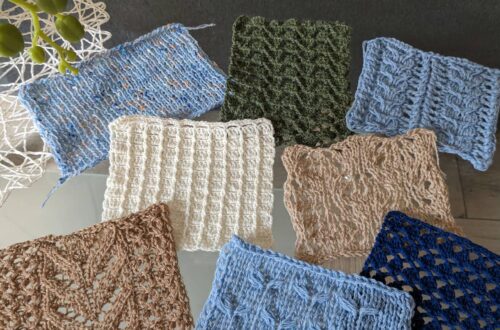
First we knit swatches of the patterns and work out the gauge.

I knitted my swatches on 3.25 mm needles. Stockinette stitch over 10 cm: 22 stitches × 3 rows.

The width of one lace pattern repeat (9 stitches) = 4 cm

Neckline calculations.

For example, if the upper arm circumference = 36 cm, then the sleeve needs: 36 cm/4 cm = 9 lace pattern repeats.

Or, if the desired sleeve width (including ease) is 40 cm, then the sleeve needs: 40 cm/4 cm = 10 lace pattern repeats.

An important point.

In this model we knit an Asian-style back raise and add stitches to form the underarms, and this will increase the width of the sleeve.

So this must be taken into account at the start of the neckline.

Example 1. If we pick up 18 stitches along the side of the back raise and the underarm when forming the sleeve, that gives 2 extra lace pattern repeats. If the sleeve needs 10 repeats in total, then 2 of them will be knitted from the extra stitches of the back raise and the underarm. So from the neckline the sleeve width should be: 10 repeats – 2 repeats = 8 repeats.

Example 2. If we pick up 27 stitches along the side of the back raise and the underarm when forming the sleeve, that gives 3 extra lace pattern repeats. If the sleeve needs 10 repeats in total, then 3 of them will be knitted from the extra stitches of the back raise and the underarm. So from the neckline the sleeve width should be: 10 repeats – 3 repeats = 7 repeats.

For my yoke I will use the calculations from example 2.

For the neckline, on 2.75 mm needles I cast on 132 stitches + 1 stitch for joining in the round. Work 11 rounds of 1×1 rib. Then switch to 3.25 mm needles. Divide the stitches into sections as shown in the picture and start knitting the yoke.

In the first round of the yoke, knit the stitches of all sections, purl the raglan lines, and also add one stitch for each sleeve next to the raglan lines of the front. This is needed for the symmetry of the lace pattern. From now on we have 64 stitches for each sleeve.

For the front, increase on every round next to the raglan lines, over the whole length of the yoke.

For the back, at first also increase on every round for about 2/3 of the yoke length, then on every other round.

When the yoke is 20 cm long, the stitch counts for each section will be:

  • front – 97 stitches,
  • back – 85 stitches,
  • sleeves – 64 stitches each,
  • raglan lines – 1 stitch each.

We start the Asian-style back raise on the back stitches + 2 raglan line stitches (one on each side). 12 short rows in total.

Next, we separate the sleeve stitches and put them on extra waste yarn.

Join the front and back stitches, form the underarms (20 stitches each in my case) and continue knitting the main part of the piece in the round to the desired length.

Now there are 226 stitches in total on the 3.25 mm needles. We knit the main part of the piece as a straight fabric in stockinette stitch. At the bottom, work a few rows of 1×1 rib.

If you like, you can use the lace pattern from the sleeves starting at the bust line, at the waist, or on the lower part of the piece.

After knitting 7–8 cm of the main fabric from the armholes, I decided to continue with the sleeves to find out whether I had enough yarn.

After the yoke was finished (from the very start), we had 64 stitches for each sleeve. Along the side of the back raise and the edge of the underarm I picked up another 26 stitches for each sleeve: 64 + 26 = 90 stitches. That makes 10 repeats of the lace pattern.

Knit each sleeve in the round as a straight, even fabric to the desired length. Then switch to 2.75 mm needles and work 10 rows of 1×1 rib and 2 rows of tubular (double-knit) rib, then bind off with a tapestry needle. My sleeve length from the underarm to the lower edge is 20 cm.

The sleeves are done, so I return to the main fabric. I continued in stockinette stitch to the desired length.

I do not change needles (3.25 mm); I work 10 rows of 1×1 rib and 2 rows of tubular (double-knit) rib, then bind off with a tapestry needle.

The result is a lovely summer outfit: a new, light and almost weightless T-shirt.

This model will fit perfectly into any wardrobe.

Size of the finished piece: 48–50. Length: 60 cm, width: 56 cm. Weight: 260 g.

You can see photos of the T-shirt on me in the video, part 3, Photo Album.