For Women,  Knitting Projects,  Tops & T-shirts

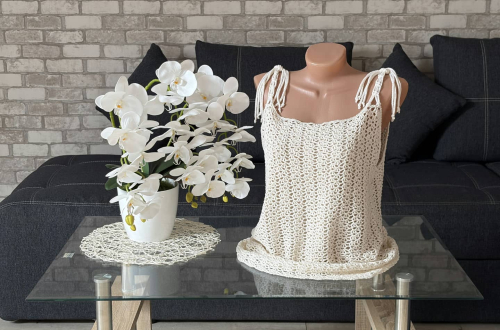
Top-Down Knitted Cotton T-Shirt with Round Lace Yoke

A knitted T-shirt is a simple, practical and at the same time refined wardrobe staple. The round yoke adds elegance and romance, making the piece stylish and versatile. And the lace pattern creates an attractive look. The T-shirt pairs easily with all kinds of clothes, from jeans and shorts to skirts and classic trousers, which makes it an indispensable item in your wardrobe.

Thanks to its structure, the piece holds its shape beautifully and fits comfortably. This is especially important for those who value comfort in everyday life, because such a T-shirt does not restrict movement and lets you feel free all day long.

For this project I chose 100% cotton in two different lots, because I did not have enough yarn. Yardage 250 m/100 g. 3.5 mm needles.

Gauge in stockinette stitch: 22 sts × 30 rows = 10 cm.

We knit the T-shirt from the top down in one piece. My calculations are for size 48–50 (≈ EU 42–44, M–L).

We start with the neckline. On 3.5 mm needles, cast on 132 stitches. Work 10 rounds of 1×1 ribbing in the round. Then knit the yoke in the textured lace pattern following the chart in the gallery below. The repeat at the top of the chart is 24 stitches.

For the width I wanted, and given my gauge, I need 9 pattern repeats for the main body and 3 repeats for each sleeve. The stitches of one repeat (or another number, as the stitch count may differ for other sizes) will be added at the underarms, which allows us to increase the width of the main body and the sleeves. With that in mind, for the yoke I take only 8 pattern repeats for the main body and 2 repeats for each sleeve: 8 + 2 + 2 = 12 repeats.

I have 132 stitches on the needles, and I work out how many stitches fall to one repeat:

132 stitches / 12 repeats = 11 stitches.

So I start knitting the yoke from row 6 of the chart. In exactly this row the repeat is 11 stitches.

If you like, you can make the neckline smaller and the collar narrower.

To do this, cast on fewer stitches and you can start the yoke from the first row of the chart. For example, 12 repeats × 9 stitches (one repeat) = 108 stitches.

Knit the yoke completely following the chart (from row 6 to row 39). In the last row of the pattern I worked only two increases in each repeat (the chart shows three increases). So the number of stitches in each repeat is 23 stitches.

On the needles: 12 repeats × 23 stitches = 276 stitches.

Next I knit 2 more rows of knit stitches. The height of the yoke at this stage is 18 cm.

Next, we divide the stitches into separate sections and mark them with markers, keeping the pattern symmetrical:

  • back – 80 stitches,
  • front – 104 stitches,
  • sleeves – 46 stitches each.

On the back stitches (80 stitches) we start knitting the Asian back raise in stockinette stitch, in return rows. Work 15 rows, which is about 6 cm. Then we move on to forming the underarms.

Move the sleeve stitches onto waste yarn. After the back stitches you have knitted, cast on the required number of stitches for the first underarm (I have 15 stitches). Next, knit the front stitches, add stitches for the second underarm (again 15 stitches) and join into a round with the back stitches. On the needles: 80 + 15 + 102 + 15 = 212 stitches.

Knit the main body in the round to the desired length. Then 1 round of purl and 1 round of knit again. Bind off in the classic way.

We move on to the sleeves. On the waste yarn there are 46 stitches for each sleeve. Along the edge of the underarm and the Asian back raise I pick up 24 new stitches.

On the needles: 46 + 24 = 70 stitches.

We start knitting short sleeves in the round to the required length. I worked 15 rows of stockinette stitch. Then 1 round of purl and 1 round of knit again. Bind off in the classic way.

I crocheted the lower edge of the main body and the sleeves (single crochet in the reverse direction). Length of the finished piece 58 cm.

Yarn used for the whole piece 300 g (size 48–50) .